Research First India · an initiative led by Stemious
India can research its own future.
Research First India is an initiative led by Stemious to help students and faculty do research at their own college, here in India, and to build a connected network of laboratories that contribute reliable, comparable results to shared research challenges.
In short
- What it is
- A way for colleges to build research capability with the instruments and students they have, and to contribute to shared research questions.
- Who leads it
- Stemious Solutions, Pune, the strategic partner of Vernier Science Education in India. The research itself stays with the students, faculty and labs who do it.
- Who can take part
- Students, faculty, colleges and universities, research and testing laboratories, scientists, and industry or funding partners.
- How it works
- A shared research question is divided into manageable investigations. Participating labs follow documented methods, record measurements with their context, compare results and reproduce important findings before anyone builds on them.
- What exists today
- The Stemious app with Vernier sensors, the 12-step research method, step-by-step experiments, and catalogues of proposed research ideas and short projects. The lab network and the national missions are being built.
- How to begin
- Pick one first step from the table below. Each says whether it is available now.
One question, many labs, every result checked.
Most college research today happens alone: each lab picks its own question, method and settings, so results rarely compare and are rarely repeated. Research First India works the other way.
Four stages, each with its own purpose.
- Guided experimentBuilds foundational skill: handling instruments, collecting clean data, reading a graph.
- ReplicationRepeating a published result develops method and discipline, and tests whether the result holds.
- Original investigationA defined research question the student or team answers with their own design.
- Mission contributionAn investigation that is one piece of a shared goal, run on a common method so it adds up.
Start small and specific.
| You are | A useful first step | Status | |
|---|---|---|---|
| A student | Explore a short digital twin project you could run in one to six weeks | Available now | Browse short projects |
| A faculty member | Discuss a project for one student team, with its method and instruments | Available now | Request a conversation |
| A college | Assess your instruments and research readiness | Available now | Request a readiness review |
| A laboratory | Register what your lab can measure and who can book it | Being built We record it now; the public lab map comes later | Tell us about your lab |
| A scientist | Explore leading a mission challenge in your field | Missions forming | Start a conversation |
| Industry or a funder | Discuss a defined challenge or a pilot | Available now | Start a conversation |
Operating, being built, and the ambition.
Available today
- 60+ Vernier Go Direct sensors supported in the Stemious app, supplied and supported in India
- 240 ATALUP labs
- 530 IB, CBSE, ICSE and Cambridge labs
- The 12-step research method, working on Vernier instruments
- 1,437 data-driven research ideas and 653 short digital twin projects, proposed and awaiting scientific review
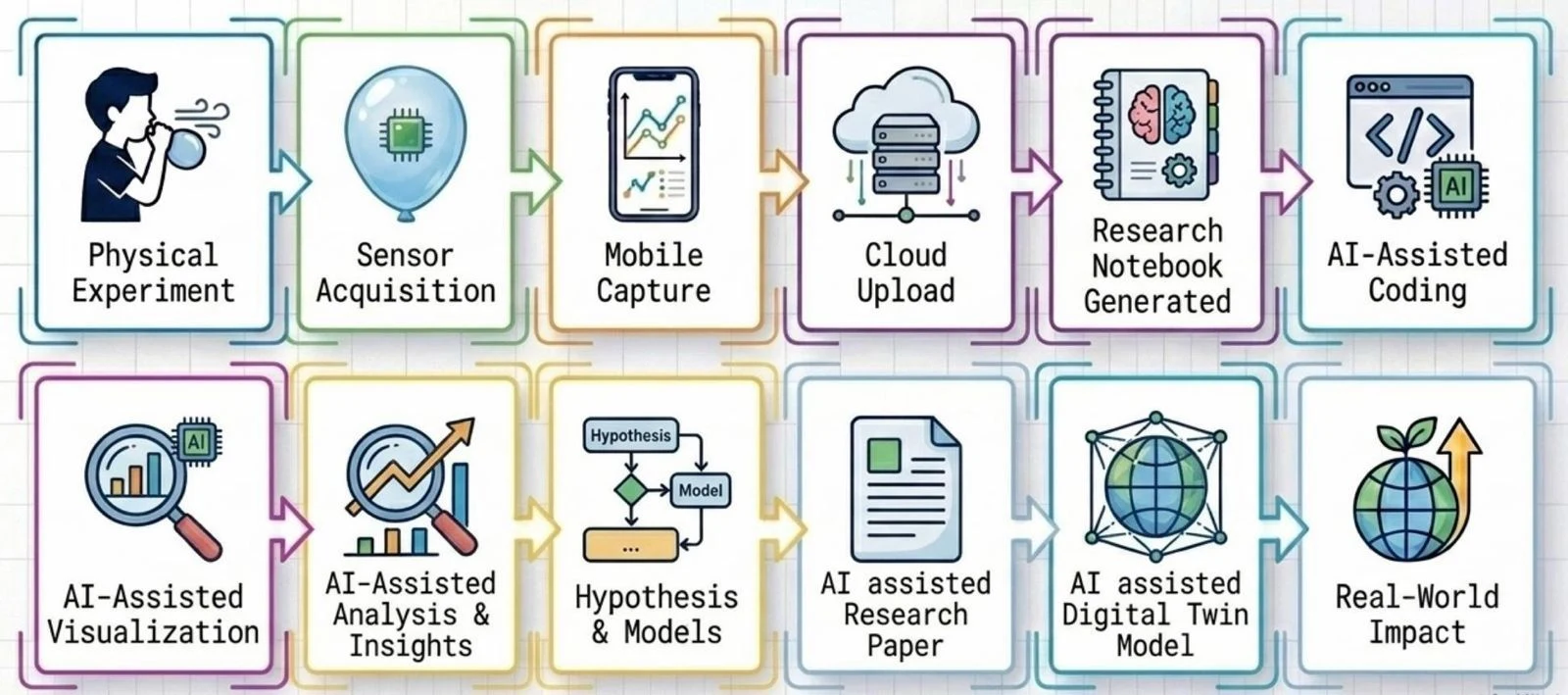
- Two worked digital twins with their data: a pendulum and a balloon with its research paper
In progress
- 3,000 more step-by-step experiments, including 1,000+ breadboard, electronics, IoT and Arduino labs
- A map of lab capability: 83 labs listed from public information, none confirmed yet
- A research grant helper tool
- Challenge trees and methods for the first missions
Where it goes
- National missions run by many labs together, each with a scientist leading it
- College labs working to the standards that research and testing need
- Products, instruments and companies built in India from the results
No college, laboratory or institution named on this site has agreed to take part unless we say so explicitly. Institutions listed against research ideas are suggested hosts only.
The talent leaves, the labs sit idle, and AI makes the work faster.
Sources: NITI Aayog, International Student Mobility working paper, November 2025 (spending abroad, about USD 34 billion, and the 2023-24 higher education budget); Government of India reply in Parliament, August 2024 (students abroad); DST R&D Statistics at a Glance 2022-23 (R&D spend for 2020-21, researchers per million for 2020); Stemious lab listing, October 2026.
Shared goals that many labs could work on together.
These missions are proposals. Each is looking for a scientist to lead it; none has started.
A planning assumption for a battery-material mission, not a demonstrated result. Ageing tests, scale-up and certification cannot be compressed as much as discovery.
Sodium-ion batteries
A battery from salt and farm waste, reducing dependence on imported lithium.
The case for it Land · proposedDynamic Soil Health Card
Seasonal soil readings by local colleges and a district model for plot-level advice.
The case for it Water · proposedWater and aquifer atlas
Groundwater and rivers measured the same way by colleges across a basin.
The case for it Instruments · proposedIndia-made lab instruments
Spectrophotometers and other instruments designed and built in India.
The case for itWe are looking for scientists to lead the first missions.
A mission needs one person who can hold the science together for five years or more: set the target, write the first methods, choose challenge leads and decide what moves up. Stemious runs the coordination, data and lab network around them.
- Deep experience in the mission's field, from a university, national lab or industry
- Able to give the mission a large share of their time for several years
- Believes a result counts once a second lab has repeated it
- Wants to train the next generation as much as publish
What India could gain: a scenario, not a forecast.
We looked at 50 national research areas (74 including 24 next-generation areas) where India has the raw material, can build the equipment and faces a problem nobody abroad will solve for it.
a year of possible value across the 50 national areas by about 2047, before removing overlaps.
About USD 160 to 400 billion a year at ₹88 per USD. Each area scales one published market figure with a stated assumption; several are low-confidence. This is not revenue, committed funding or demonstrated impact. Every area, its anchor figure, assumption and source.
Questions people ask
What is Research First India?
An initiative led by Stemious to help students and faculty do research at their own college in India, and to build a connected network of laboratories that contribute comparable results to shared research challenges.
Is it a government programme?
No. It is led by Stemious Solutions, a private company in Pune. Proposed missions may later involve public institutions and funders; none has committed yet.
Do we need new equipment to take part?
Not to start. A readiness review begins with the instruments your college already has. Some investigations need specific sensors or laboratory analysis, and each research idea says so.
What does it cost?
The readiness review and first conversations have no cost. Equipment, the app and any programme support are set out in a written proposal for each college.
Can results from educational sensors be used in research?
For teaching, method development and many screening studies, yes. Vernier instruments are made for education, so results needed for regulation, medicine or commercial testing must be confirmed by an accredited laboratory.
Has any mission started?
Not yet. Four missions are proposed and each is looking for a scientist to lead it.
Two catalogues of proposals.
Counts from the catalogue data. Each idea carries a status; all are "Proposed idea" today. Ideas that need laboratory analysis beyond the listed sensors say so. See About our numbers.