Research First India · Research on connected instruments
An instrument, a recipe and a pipeline.
Research becomes repeatable when three things come together: an instrument whose readings go straight into the record, a step-by-step recipe anyone can follow, and a pipeline that carries the data from the bench to a paper and a digital twin. We start with Vernier Go Direct sensors and add every other instrument that can be connected.

Three parts that make any lab a research lab.
Readings that are never retyped
Vernier instruments connect to a phone or laptop, most of them wirelessly: 71 Vernier products (sensors, instruments and systems) across physics, chemistry, biology, environment and physiology. They are made for education, not for industrial, medical or commercial testing. Other lab equipment joins as it is connected digitally, from balances and meters to the research and testing instruments NABL labs use.
Steps anyone can follow
Every investigation is written as a step-by-step procedure with the settings, amounts and checks spelled out. A student in another city can run the same recipe and get a comparable result, which is what makes a result something others can build on.
From bench to paper to twin
Each run is uploaded with its full history, turned into a research notebook, analysed with AI help the student must check, and carried through to a paper and a digital twin.
Five things a connected, recipe-driven lab does that a normal lab cannot.
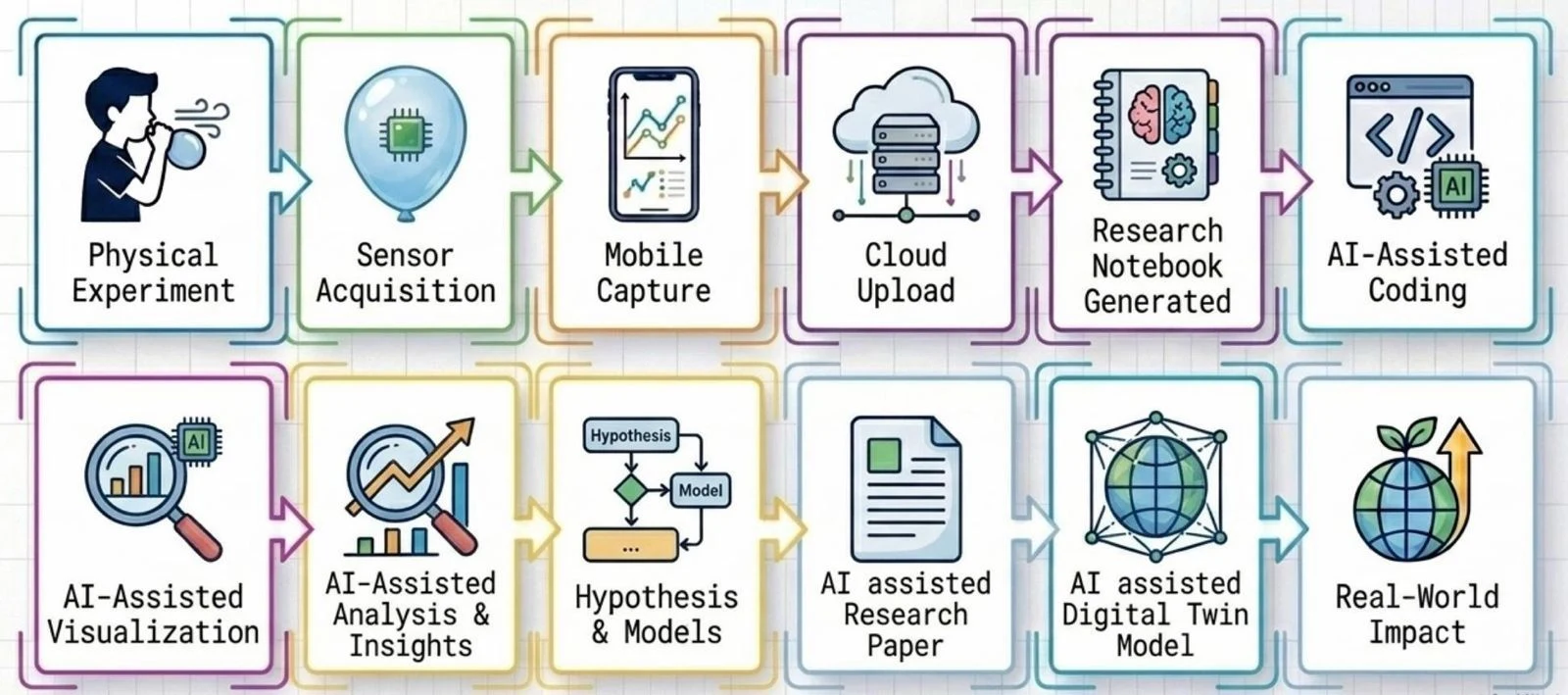
Twelve steps from an experiment to impact.
From a physical experiment to real-world impact. Every step is guided, and every step leaves evidence.
Capture
- 1Physical experimentFrame a testable question, identify variables and run the experiment yourself in a real setting.
- 2Sensor acquisitionUse Vernier Go Direct sensors to measure the physical, chemical or biological signal accurately.
- 3Mobile captureCapture readings in the app with timestamps, units and the context needed to interpret them later.
- 4Cloud uploadSecurely upload each experimental run so the original observations remain organised and traceable.
Understand
- 5Research notebook generatedTurn measurements, notes and decisions into a structured notebook that preserves the research trail.
- 6AI-assisted codingGenerate and refine analysis code while keeping the student responsible for checking every method and result.
- 7AI-assisted visualisationExplore the data through suitable charts, distributions and comparisons that reveal patterns clearly.
- 8AI-assisted analysis and insightsApply appropriate statistical reasoning, inspect uncertainty and identify findings worth investigating further.
Contribute
- 9Hypothesis and modelsCompare evidence with the hypothesis, refine explanations and build models that can be tested again.
- 10AI-assisted research paperDevelop a coherent paper from the traceable notebook, with claims grounded in the student's own evidence.
- 11AI-assisted digital twin modelTranslate the experiment into a digital model that can simulate conditions and test new scenarios.
- 12Real-world impactCommunicate conclusions, limitations and practical applications that connect the investigation to its wider context.
From one kind of instrument to every instrument.
Each stage builds on the one before.
Research on connected instruments
A Physical AI and sensor lab built on Vernier Go Direct instruments, with every reading captured, stored and analysed through the 12-step pipeline above.
- Every student can repeat a published result in year one
- Every result is traceable from the instrument to the paper
Every instrument in the ecosystem
The equipment a college already owns, and research and testing grade instruments of the kind NABL laboratories use, connected digitally to the same pipeline.
- Readings captured automatically, never retyped
- Instruments shared across departments and colleges
Colleges that run research-grade labs
Stemious step-by-step procedures make good laboratory practice repeatable: methods, calibration records and sample logs that a college lab can follow every time, on its way to the quality standards that NABL accreditation asks for.
- Labs that serve research and industry testing
- A process the next college can copy
Accreditation is granted by NABL, not by Stemious. What we provide is the connected equipment and the repeatable process that make reaching that standard practical for an ordinary college.